

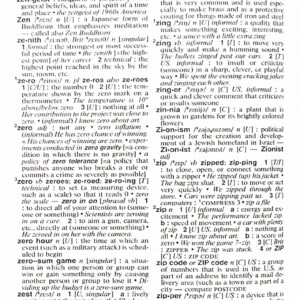
Merriam-Webster’s Essential Learner’s English Dictionary
$690.00 MXN
Merriam-Webster’s Essential Learner’s English Dictionary. Merriam-Webster’s Essential Learner’s English Dictionary is a new dictionary that is intended to serve...
ISBN-10: 0-87779-856-7
ISBN-13: 978-0-87779-856-9
Merriam-Webster’s Essential Learner’s English Dictionary.
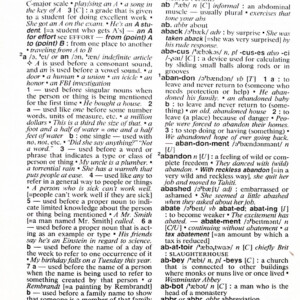
Merriam-Webster’s Essential Learner’s English Dictionary is a new dictionary that is intended to serve as an affordable and compact reference for learners of English as a second or foreign language. It is based on Merriam-Webster’s Advanced Learner’s English Dictionary and includes many of the features found in that larger book. It provides coverage of both American and British English, with a particular emphasis on American English.
The more than 54,000 entries in this dictionary include the most essential words and phrases that people are likely to need and encounter in their daily lives. The choice of entries was based mainly on the evidence in our database of citation text, which now includes more than 100 million words. We also made frequent use of online resources, such as the databases of Lexis-Nexis, which provided editors with ready access to vast amounts of material from a very wide variety of sources.
The definitions in this dictionary are written in simple language. Notes of various kinds are also used to help clarify aspects of usage that cannot be easily captured or expressed in a definition. The inclusion of examples showing how words are used is an important feature in any dictionary, and it is particularly important in a learner’s dictionary. Most of the entries and senses in this book therefore include at least one example, and many include more than one. The examples have been carefully chosen to show words being used in appropriate contexts which accurately reflect their uses in actual speech and writing. Many of the examples are enhanced by the inclusion of highlighted phrases, explanatory glosses, and synonyms.
Merriam-Webster’s Essential Learner’s English Dictionary was created by the editorial staff of a company that has been publishing dictionaries for more than 160 years. The dozens of people who worked on our Advanced Learner’s English Dictionary can also be said to have contributed to this abridgment. The people who worked specifically on this project as definers were Penny L. Couillard-Dix, Benjamin T. Korzec, Emily A. Brewster, Rebecca Bryer-Charette, Karen L. Wilkinson, Susan L. Brady, and Kory L. Stamper. The task of checking cross-references was handled by Maria Sansalone, Donna L. Rickerby, and Adrienne M. Scholz. Pronunciations were provided by Joshua S. Guenter. Copyediting was done by Stephen J. Perrault and Penny L. Couillard-Dix. The final review of the manuscript was by Stephen J. Perrault.
Proofreading was done by most of the editors mentioned above. Donna L. Rickerby keyed revisions to the data file and provided technical assistance. Susan L. Brady directed the steps that turned the manuscript into pages ready to be printed. Project coordination and scheduling were handled by Madeline L. Novak. Page design and layout were chiefly handled by editors Brady and Novak. Company president John M. Morse assisted in the book’s initial planning and was supportive throughout the project.
Learning a new language is a difficult challenge. We believe that Merriam-Webster’s Essential Learner’s English Dictionary contains a wealth of useful and practical information that will help students of English to better understand the words and expressions that they hear and read, and to choose the best way to express themselves in their own speech and writing.
Technical Sheet
- One excellent printed books
- Format 10.5 x 17.7 x 5.7 cm
- 1,406 pages printed in black and white
- Language English
- Fine softcover binding
- 2010 Edition
- 3rd printing Quad Graphics Martinsburg, WV March 2014
- ISBN-10: 0-87779-856-7, 0877798567
- ISBN-13: 978-0-87779-856-9, 9780877798569
- © Merriam-Webster, Inc.
- Weight: 648 g
Content
Preface.
Using the Dictionary.
Labels Used in This Dictionary.
Pronunciation Symbols.
A Dictionary of the English Language.
Irregular Verbs.